Showing posts with label Electric. Show all posts

Friday, September 10, 2010

Concept Car : Kia POP

Kia POP concept car has been unveiled by KIA as its latest concept car just a few weeks before its official debut at Paris Motor Show this year.


Kia POP concept car is a compact and electric powered car concept which has an odd shape. This concept car�s power will comes from an all-electric drivetrain. While for its interior, Kia POP concept car featuring two seat for its passenger.


Saturday, August 21, 2010

Concept Car : The Opel Ampera hybrid on pure electric power 2011

The Opel Ampera will be a plug-in hybrid with a 65 km range on pure electric power Design Sketch


This project is the first Opel amps with permission of the loss of the "European Office for Harmonization in the Internal Market (OHIM), where documents are stored in nature.


      Opel ampere is the European version of the Chevrolet Volt from GM Hybrid will go on sale next year, the North American market.


      Measured against these pictures, it seems that are available to the project, the current Opel model amps and length of the keys to the new Insignia, which recently won the European Car of the Year.

      Amplifiers are Voltec GM hybrid powered concept was seen in the last Cadillac approach, which debuted at the Detroit auto show in January. It has combined an electric motor with a gasoline engine used to charge the lithium-ion batteries. It is up to 40 miles (65 km), clean power and can be downloaded for about 2-3 hours at 230 V European standard. Use of gasoline as the generator is battery operated, Ampere range approximately 500 miles (or 800 km).


Ampere expected sales in 2011 and in Europe has its official debut at the Geneva Motor Show in Geneva next month .

Tuesday, March 2, 2010

Concept car : BMW Active Hybrid X6 2010

 
BMW announced the production version of the BMW ActiveHybrid X6. The BMW ActiveHybrid X6 will make its world premiere at the Frankfurt Motor Show (IAA) in September and will reach US BMW Centers in fourth-quarter 2009. The overall drive system featured in the BMW ActiveHybrid X6 consists of a 400 hp twin-turbocharged V8 gasoline engine and two electric synchronous motors delivering 91 hp and 86 hp, respectively. Maximum system output is 480 hp, and peak torque reaches 575 lb-ft. 
 
Precisely controlled interaction of the three power units optimizes the overall efficiency of the BMW ActiveHybrid X6 at all speeds, with acceleration from a standstill to 60 mph in 5.4 seconds. Top speed of the BMW ActiveHybrid X6 is limited electronically to 130 mph, with average fuel consumption in the EU test cycle improved by roughly 20%, and a CO2 emission rating of 231 grams per kilometer. EPA ratings will be available closer to the market introduction.

BMW ActiveHybrid X6 able to run exclusively on electric power � and that is entirely free of CO2 � up to a speed of 37 mph (60 km/h), with the combustion engine being activated automatically whenever required. With the two electric motors, three planetary gearsets and four multi-plate clutches, drive power is transmitted through a 7-speed automatic transmission. As would be expected in a BMW, the driver can operate the transmission manually. BMW�s lauded xDrive all-wheel-drive system distributes the power between the front and rear axles.

Monday, March 1, 2010

Concept Car : Renault Peugeot Citroen C Zero 2010

A concept already seen! look as Mitsubishi i-MiEV. Citroen has just adapted the car to house style, as Peugeot with the ion.


PSA (Peugeot-Citroen), the politics of electric vehicles is to partner with specialists. Thus, after the Berlingo First Electric, developed with Venturi Automobiles, the Group has approached Mitsubishi Motors Corporation, to develop the C-Zero. This strategy shows some caution on the part of PSA, in contrast to gamble in terms of investment, offers an electric Renault. The group prefers the hybrid, less revolutionary. Question of culture!


Technically, the C-ZERO has a synchronous motor with permanent magnet delivers 47 kilowatts (64ch) between 3000 and 6000 rpm. The maximum torque of 180 Nm is constant from 0 to 2000 rpm. The fall of torque from 2000 rpm is needed is the technical defluxing, familiar to electricians. The motor power is provided by batteries last generation of Lithium-ion implanted in the center of the vehicle in the floor. The stored energy is 16kWh issued a voltage of 330V.


Performance side, there is only one number to remember: 130. The car can travel 130 km on a single charge and maximum speed reaches 130 km / h. A city with a capacity of peri-urban. Know that in France, 70% of car trips daily on weekdays, are less than 30 km, for an overall average of 40 km.


As the ion Peugeot, the C-Zero will be marketed in 2010 and will be eligible for bonuses Government 5 000 �. Why miss out?

Sunday, September 13, 2009

Concept Car : Peugeot Three Wheeled Hybrid


Ecofriend has an interesting post about the three-wheeled vehicle above that is called a Peugeot plus. Econfriend says the car runs on an electric motor and aims to have almost no carbon footprint.

it's a hybrid, between a scooter and a car. This combination allows using a smaller electric engine, saving energy. This saving generates less pollution and a major autonomy of the batteries. Besides the small size gives more agility into the traffic and makes easier to find parking.

Sunday, July 19, 2009

2010 Audi e-Tron Concept a compact sports car with all-electric drive

Audi is showing an uncompromising purist compact sports car with all-electric drive at the 2010 NAIAS. The Detroit Audi e-tron Concept is 3.93 meter (154.72 in) long and 1.78 meter (70.08 in) wide but just 1.22 meter (48.03 in) tall two-seater; just a few months after the debut of the Audi e-tron Concept at the 2009 Frankfurt Motor Show, this is now the second electric concept vehicle from the brand with the four rings. Coupled with the Detroit Audi e-tron Concept's low gross weight of around only 1,350 kilograms (2976.24 lb), high-torque power units driving the rear wheels guarantee commensurate road performance.

2010 Audi e-tron Concept Car
Two electric motors in sync with a total capacity of 150 kW (204 hp) Audi give Detroit Audi e-tron, use the concept of the performance of a real sports car. Concept car can accelerate from 0 to 100 km / h (0 to 62.14 mph) in 5.9 seconds, if necessary, and goes from 60 to 120 km / h (37.28 to 74.56 mph) in 5.1 seconds.

2010 Audi e-tron Concept Car
And a top speed limited to 200 kmh (124.27 mph), the amount of energy needed to increase the electric motors are disproportionately in speed. Fraction in the combined cycle NEP nearly 250 kilometers (155.34 miles). The energy storage unit in charge of household current (230 volts and 16 amps) through the cable and components.

2010 Audi e-tron Concept Car
Socket behind a curtain in the back of the car. Download time when the battery is approximately 11 hours, but the heavy current (400 volts and 32 amps) of these cuts to about two hours only.
The Detroit Audi e-tron Concept in its further developed version goes one decisive step further into the future; an electro-mechanical brake system means the potential of electric motors for energy recovery can now be exploited. A hydraulic fixed-caliper brake is mounted on the front axle, with two novel, electrically actuated floating-caliper brakes mounted on the rear axle. These floating calipers are actuated not by any mechanical or hydraulic transfer elements, but rather by wire ("brake by wire"). In addition, this eliminates frictional losses due to residual slip when the brakes are not being applied.

2010 Audi e-tron Concept Car
The drive system's power is transferred to the road by the rear wheels, reflecting the Audi e-tron's weight distribution of 40:60.
Both the individual motors, which are installed behind the wheels close to the vehicle's center line as wheel drives, also enable the Detroit Audi e-tron Concept's lateral dynamics to be intelligently controlled. This also boosts traction. Similar to what the sport differential does in conventional Audi vehicles, torque vectoring - the targeted acceleration of individual wheels - makes the newly developed electric drive of the Detroit Audi e-tron Concept even more dynamic while simultaneously enhancing driving safety.
Understeer and oversteer can be corrected by not only targeted activation of the brakes, but also by precise increases in power lasting just a few milliseconds. The concept car remains extremely neutral even under great lateral acceleration and hustles through corners as if on the proverbial rails.

2010 Audi e-tron Concept Car
The chassis has triangular double wishbones made of forged aluminum components at the front and rear axles - a geometry that has proven in motor sports to be the optimal prerequisite for high agility, uncompromising precision and precisely defined self-steering behavior. A taut setup was chosen for the springs and shock absorbers, but it is still very comfortable.
Audi e-tron concept car moves on wheels 19-inch 35 - spoke design. 235/35 front tires and 255/35 rear tires provide excellent grip. Other special feature of tires: Audi designers created a special file for the Detroit Audi e-tron, use the concept.

Wednesday, May 13, 2009

Concept Car : MAZDA KAAN E1 RACE CAR

Unlike some of the other entrants in this year�s LA competition, Mazda hasn�t forgotten to pen its concept with childlike awe; the Kaan features a sweeping, aerodynamic shape constructed with plenty of carbon. The centre-less wheels look strangely like beer bottle openers from the side - though not many bottle openers have light beams running across their centres.


Also unique among all the entrants is the idea that Kaans don�t compete alone, but rather in a peloton - a close knit pack of cars in formation like cyclists in a race. According to Mazda, the closer the pack sticks together, the more aerodynamic and thus faster it becomes. A lightning bolt inspired all that, allegedly.

Early Retirement or Podium Finish: Finishes just outside the top three when one of the peloton gets too close and clips another during the final lap, causing a multiple comedy tankslapper among the entire pack.


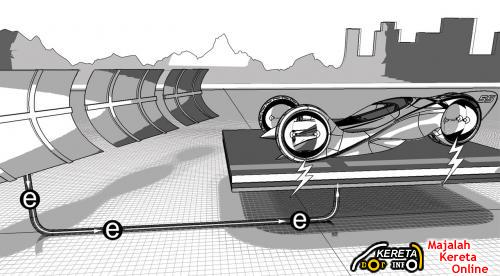
The MAZDA KAAN is an electric race car designed to compete in the E1 races, the pinnacle of international motorsports in terms of technology and popularity. In 2025, California freeways have been resurfaced with a sub-level electro-conductive polymer that powers the electric cars of the modern world. MAZDA�s patented electronic tire system uses this technology to power the KAAN to reach 250 mph with no harmful emissions!

The vehicles are piloted by individual drivers but teams are made up of thirty cars, all on the track together. Using strategies similar to those in cycling peletons, the tighter the group sticks together, the more aerodynamic and powerful it becomes.


Inspiration for the KAAN comes from electric fields and textures seen in nature, particularly those in a lightning bolt. The car is uniquely designed around its powerful electric wheels while the cockpit acts as a capsule to safely house the driver, allowing for tighter peloton formations and a team victory.

Tuesday, April 28, 2009

Concept Car : Peugeot Stylight


Another entry from the Peugeot Design Competition is the Stylight, a 3-seater city hybrid car with a small 1.6-liter engine and an electric motor placed above the rear wheels. Ognyan Bozhilov, the designer, said that this arrangement �improves weight distribution, gets rid of the complex, heavy mechanics for power transmission and makes the unique, aerodynamic body possible.� The Stylelight also offers unique safety features: an expansive windscreen for maximum visibility, and LED tail lights designed so the harder you press, the more lights turn on.

Concept Car : BamGoo Electric Bamboo


The body of the BamGoo is made out of bamboo. Designers from Kyoto University, and the City of Kyoto (home to the famous environmental protocols), demonstrated how organic material like bamboo�which is light, very strong and grows very fast�might be incorporated into car design. The single-seat all-electric car weighs on 130 pounds and can travel 30 miles on a charge.